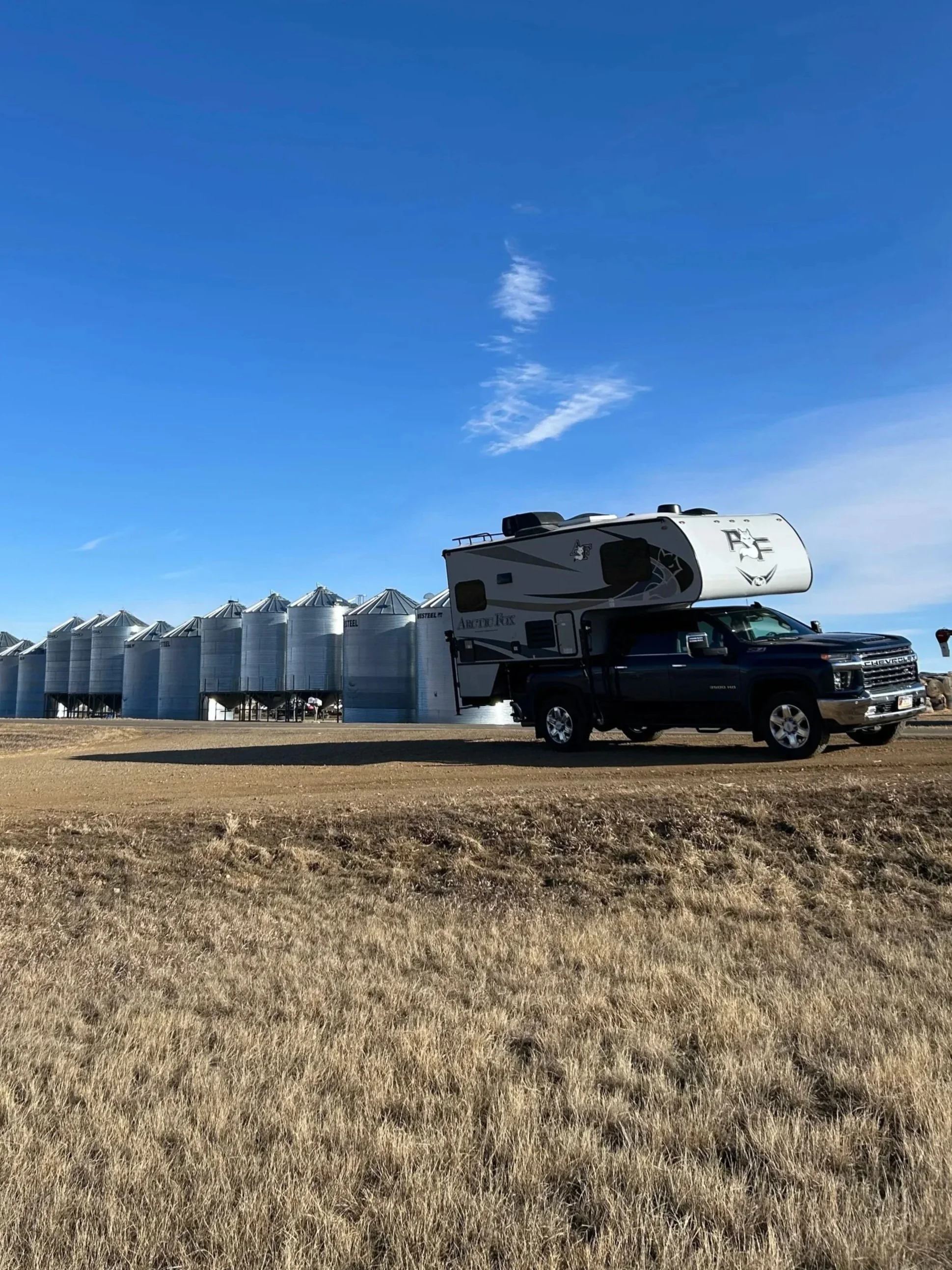
What We Heard Across 19 States
Different states, farms, crops, livestock, agricultural scales. Same conversation.
Over two months and 10,000 miles, we spoke with dozens of producers across regions, crops and operation sizes.
1. When we plant, we don’t know what prices will be when we harvest.”
Farmers commit to a season before they know what prices will be when they harvest.
Land is committed.
Operating loans are signed.
Seed, fertilizer, chemicals and fuel are purchased and applied.
For months, the crop is tended.
By the time market prices are known, the critical decisions have been made.
Change is biologically impossible.
That has always been part of farming.
What has changed is what that uncertainty means.
In earlier periods, price swings affected margins.
A good year or a bad year.
Today, for many producers, price swings determine whether the farm remains solvent for another season.
2. “We take what they give us.”
That sentiment came up repeatedly, across crops and livestock, regions and operation sizes.
Producers described a system where the price of what they produce is determined by forces they can’t influence.
Global supply and demand.
Currency movements.
Trade decisions.
Interest rates.
Market reactions to events far removed from the farm.
None of those are things a producer can control or respond to in real time.
Several farmers made the same point in different ways:
You manage your operation well.
You hit your yields.
You control your costs.
And at the end of the season, the price is the price.
One producer put it plainly:
“We can do everything right and still lose money.”
In that environment, outcomes are not driven only by decisions made on the farm.
They are driven by where the market is when the crop is sold.
3. “Most years, we’re just hoping to break even.”
Across regions, crop and livestock producers described operating in conditions where covering the cost of production is not a given.
Not every year.
Not every crop.
But often enough that even diversified operations do not consistently generate a profit.
Several operations described years where:
• strong yields did not translate into strong returns
• efficient operations still struggled to cover total costs
Several producers described planting across multiple crops and finding that only one, or sometimes none, generated a profit in a given season.
Others described maintaining rotation across large acreages, not because it is profitable in the moment, but in the hope that markets will return.
Many producers said that off-farm income has become necessary to make the operation work.
In some cases, it is the only way to afford health insurance.
The issue is not poor management or adverse conditions.
It is that the price received does not reliably cover the cost of production.
4. “Input costs increase every year. This is not sustainable.”
Across regions, producers described input costs, including fertilizer, seed, chemicals, machinery and fuel, as consistently rising, with periodic spikes that are difficult to anticipate or absorb.
Farmers plan as best they can.
But pricing for key inputs can rise significantly between seasons, and sometimes within them.
Several producers pointed to fertilizer as an example:
recently, prices for anhydrous ammonia nearly doubled in a matter of weeks.
Others described themselves as “price takers” on both inputs and processing.
One producer said:
“I have no idea where their prices come from.”
Another said:
“We’re buying at retail and selling at wholesale.”
The issue is not just that costs are high.
It is that they are opaque, concentrated and essential, and thus largely outside the producer’s control.
5. “Get big or get out.”
Across regions, expansion was frequently described not as opportunity, but as essential to survival: increasing acreage or herd size to spread fixed costs.
Producers described growth as defensive:
not to make more money
but to survive.
At the same time, larger scale brings:
• higher capital exposure
• greater land, herd and equipment requirements
• increased labor requirements
• increased operational complexity
• increased operational risk
Several producers noted that rising land values further increase exposure, requiring more borrowing to secure or retain acreage.
Others described the need for additional operating capital and equipment financing as scale increases, particularly in livestock operations where feed, facilities and timing introduce additional cost and risk.
The result is a system that encourages producers to take on increasing levels of risk in order to remain viable.
6. “There’s only one place to sell.”
At key points in the system, including selling grain, processing livestock and accessing markets, options are often limited.
In many areas, producers described:
• a single nearby elevator
• a single processor
• a small number of buyers
• limited or no negotiating leverage
Several producers described consequences when attempting to sell outside those channels.
One example described a rancher bringing cattle to a processor that offered less than his cost of production.
When he refused, other processors also declined to buy.
Even where multiple buyers exist, pricing was often described as coordinated or functionally uniform.
Access exists.
Choice is constrained.
7. “We make it work however we can.”
Across regions, producers described a range of strategies used to keep operations viable when margins fall short.
These included:
• off-farm income
• refinancing or restructuring debt
• delaying equipment purchases or maintenance
• reducing labor or relying on family labor
• drawing on equity built over time
Several producers also described entrepreneurial efforts to supplement or replace traditional farm income.
These included roadside produce stands, greenhouse operations, direct-to-consumer and direct-to-retail sales, CSA and cooperative models, organic production and labeling, maple syrup operations on previously unfarmed land, trucking and other side businesses.
These efforts reflect a willingness to adapt and a capacity for innovation.
Driving across central Illinois with an organic farmer and educator, I pointed to miles of tilled ground prepared for planting and asked whether organic production could scale to that landscape. He did not answer.
Several producers noted that these approaches are often limited in scale and do not fully offset the economics of core commodity production.
In many cases, farm operations continue not because they are consistently profitable, but because losses are absorbed or deferred.
Closing
Across regions, crop and livestock operations and across operation sizes, these patterns were repeated with striking consistency.
They are not a series of isolated challenges.
They are the predictable outcomes of system design.
The issue is not that producers are failing to adapt.
Across regions, they are adjusting, diversifying and absorbing risk wherever possible.
The issue is that the structure of the system places risk on the producer while limiting control over both costs and pricing.
In that environment, outcomes are not determined solely by management decisions.
They are determined by the structure within which those decisions are made.